
Introduction
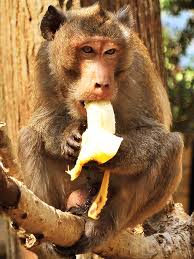
Monkeys and bananas are often symbolically linked in popular culture, but the reasons behind this association are far more complex and rooted in evolutionary history. While not all monkeys eat bananas regularly in the wild, those that do are influenced by millions of years of biological adaptation, ecological interactions, and changing environments. Understanding why monkeys eat bananas requires a journey through the evolutionary history of primates and the fruiting plants they interact with.

The Origins of Primates and Frugivory
Primates, the biological order that includes monkeys, apes, and humans, first appeared over 55 million years ago during the Paleocene and Eocene epochs. These early primates were arboreal, tree-dwelling mammals with adaptations for grasping branches and stereoscopic vision. One of their most significant evolutionary traits was their tendency toward frugivory—the consumption of fruit.
Frugivory likely evolved as a survival strategy in forested environments where fruit was a rich, seasonal source of sugar and water. These early primates developed color vision to distinguish ripe fruits, a trait still present in many monkey species today. Over time, fruit became a primary food source for many lineages, shaping their digestive systems, behaviors, and even social structures.
Co-evolution with Fruit-Bearing Plants
Monkeys and fruit-bearing plants have co-evolved in a mutually beneficial relationship. As primates consumed fruit and dispersed seeds through their feces, they supported the propagation of the plants. In return, plants evolved to produce fruit that was more appealing, nutritious, and accessible to their seed-dispersing consumers.
The banana, genus Musa, is believed to have evolved in Southeast Asia around 10 million years ago. Wild bananas are quite different from the domesticated varieties common today. They contain hard seeds and are often starchy or bitter. Nevertheless, wild bananas offered early primates a valuable food source, rich in carbohydrates, vitamins (especially vitamin B6 and C), and potassium.
For early monkey species, bananas were part of a diverse tropical diet that included figs, mangos, guavas, and other fleshy fruits. Their digestive systems adapted to break down plant matter and sugars efficiently. This co-evolutionary relationship ensured that primates would continue to seek out and rely on fruit as a staple of their diet.
Geographical Distribution of Monkeys and Bananas
It’s important to note that not all monkeys evolved in areas where bananas naturally occur. There are two primary monkey groups: Old World monkeys (found in Africa and Asia) and New World monkeys (found in Central and South America).
Bananas are native to Southeast Asia and were not historically found in the Americas or large parts of Africa until they were cultivated and transported by humans. As a result:
- Old World monkeys, such as macaques and baboons, were more likely to encounter wild bananas or closely related species in their natural habitats.
- New World monkeys, such as capuchins and howler monkeys, evolved with other native fruit species like figs, palm fruits, and passion fruits, but not bananas until after human introduction.
The image of monkeys eating bananas, while culturally ubiquitous, therefore reflects a particular subset of monkey species and ecological contexts.
Domestication and the Modern Banana
The bananas most familiar to humans today—sweet, seedless, and bright yellow—are the result of human domestication, not evolution in the wild. These cultivars are largely derived from two wild species: Musa acuminata and Musa balbisiana. Through centuries of selective breeding, humans created banana varieties with reduced seeds, softer texture, and sweeter taste.
These domesticated bananas became globally popular and were introduced to Africa, the Americas, and other tropical regions through trade and colonialism beginning around 2,000 years ago. As bananas became more widespread in tropical zones, local monkey populations began to encounter them, especially near agricultural areas and human settlements.
In modern times, monkeys in places like India, Thailand, and Costa Rica often raid banana plantations or receive bananas from tourists and locals. These interactions are human-facilitated and represent a relatively recent phenomenon in the evolutionary timeline.
Nutritional Appeal and Behavior
Why do monkeys prefer bananas when given the choice? The answer lies in their nutritional profile and sensory appeal:
- High Sugar Content: Monkeys, like many frugivores, are drawn to sugary foods. Ripe bananas offer quick energy and are easier to digest than fibrous plant materials.
- Soft Texture: Bananas are soft and easy to chew, especially for younger or older monkeys with dental wear.
- Aromatic Compounds: The smell of a ripe banana, rich in esters and other volatile compounds, is highly attractive to primates with advanced olfactory senses.
- Behavioral Conditioning: In environments where bananas are frequently offered, monkeys may develop preferences through positive reinforcement.
However, excessive consumption of cultivated bananas—high in sugar and low in fiber—can lead to health issues in captive monkeys, such as obesity, dental decay, and nutritional imbalances. As a result, zoos and wildlife centers often limit banana intake and promote more balanced diets that mimic wild food sources.
The Cultural Myth vs. Evolutionary Reality
The image of a monkey holding a banana has become a global cultural icon, appearing in cartoons, advertising, and children’s media. While based in truth, this image oversimplifies a much more nuanced evolutionary story. Monkeys eat a wide variety of foods, including insects, leaves, flowers, nuts, and even small animals, depending on the species and habitat.
In the wild, bananas—when available—are one fruit among many. The idea that all monkeys primarily eat bananas is a product of human observation, interaction, and media portrayal, rather than strict biological fact.
Conclusion
The evolutionary reasons monkeys eat bananas are rooted in millions of years of adaptation to frugivory, co-evolution with fruit-bearing plants, and the geographic availability of those fruits. While the modern banana is a human invention, its appeal to monkeys is based on innate preferences for sweet, energy-rich foods. The cultural association between monkeys and bananas reflects both evolutionary truth and modern myth, shaped by ecology, biology, and human storytelling.
As we continue to study primates in both wild and captive settings, it becomes clear that their diets—and the behaviors surrounding food—are complex, diverse, and deeply tied to their evolutionary past. Bananas, though iconic, are just one piece of a much larger puzzle.

Thanks for reading!
I love Monkey
This could be better